HOW TO SEE WILD HUMMINGBIRDS IN COSTA RICA: THE ULTIMATE GUIDE!
WONDERING HOW TO SEE WILD HUMMINGBIRDS IN COSTA RICA?
This blog explains everything you need to know about seeing wild hummingbirds in Costa Rica!
Includes: The best places in Costa Rica with high probability of seeing wild hummingbirds and all about hummingbirds.
HUMMINGBIRDS IN COSTA RICA: AN INTRODUCTION
Costa Rica is a true Heaven on Earth for any wildlife lover, priding itself with the highest species diversity for an area of its size than anywhere else on the planet.
One of the most charismatic and colourful on its 500,000 species list is the dainty and darling hummingbird.
ABOUT HUMMINGBIRDS IN COSTA RICA
WHAT TYPE OF HUMMINGBIRDS ARE IN COSTA RICA?
Out of the world’s 343 known species of hummingbird, there are around 50 species that can be found in Costa Rica alone!
The Mangrove Hummingbird is Costa Rica’a rarest hummingbird species, and as the name suggests, can only be found in and amongst Costa Rica’s subtropical mangrove forests.
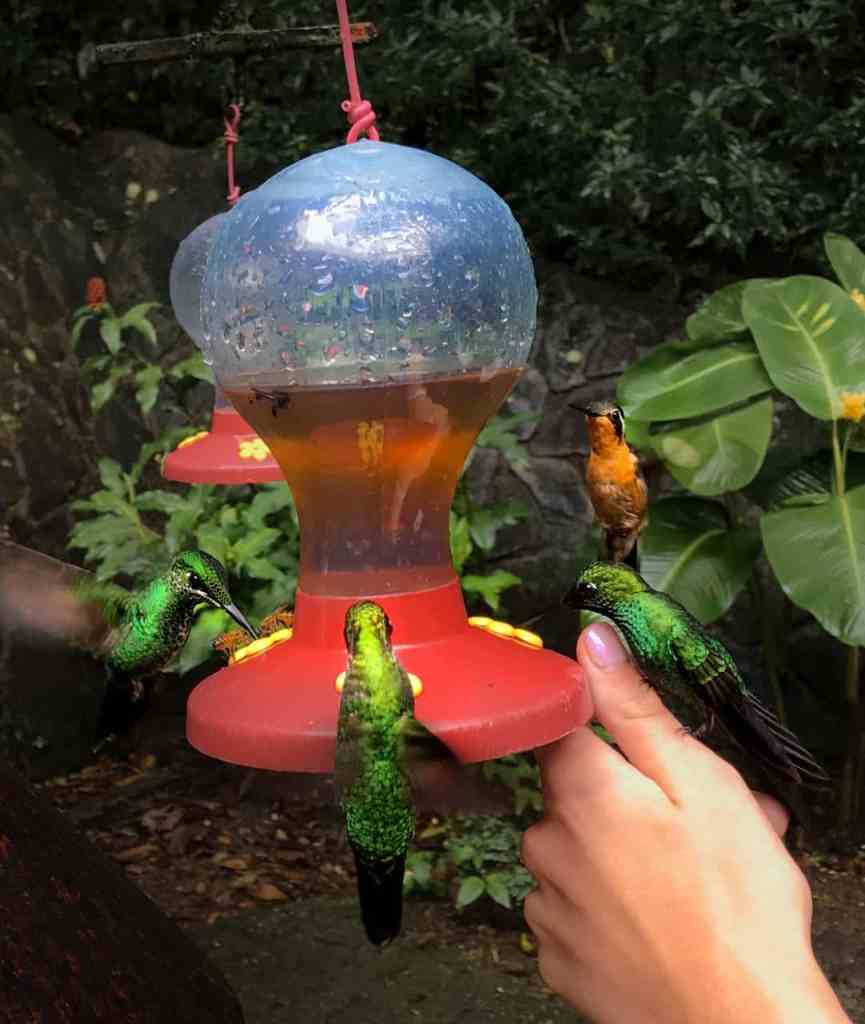
A ‘Green-Crowned Brilliant’ Hummingbird perched on my finger!
HOW MANY HUMMINGBIRDS ARE IN COSTA RICA?
There is estimated to be three times more hummingbirds in Costa Rica than in the whole of the United States! Hummingbirds in Costa Rica live here all year round and do not migrate, so there is always a good chance to see them on your visit!
THE BEST PLACES TO SEE WILD HUMMINGBIRDS IN COSTA RICA
A preferred habitat of a hummingbird generally is a tropical moist rainforest, which luckily in Costa Rica, makes up 55% of this glorious country.
Though may not always find hummingbirds all in the same place. What are called “high-elevation” hummingbirds can be found high in the mountains whereas more common species (i.e. the “rufous-tailed hummingbird”) can be even found whizzing through the lowlands including gardens and coffee plantations.
However, there a few hotspots where you are very likely to see these dazzling fast-flying creatures in the wild, one of which includes the infamous Monteverde Cloud Forest:
HUMMINGBIRD HOTSPOT – OPTION 1:
MONTEVERDE CLOUD FOREST: THE HUMMINGBIRD GARDEN
Arguably one of the most pristine and wild forests in the world, Costa Ricans consider the Monteverde Cloud Forest one of their seven natural wonders.
With a unique blanket of cloud nurturing 90% of untouched rainforest, it harbours an abundance of extremely rare plants and animals, some of which are found nowhere else in the world!
WHERE TO SEE HUMMINGBIRDS IN MONTEVERDE CLOUD FOREST
For an extremely high probability of seeing wild hummingbrds up close at Monteverde Cloud Forest, you will need to visit the Selvatura Park.
Specifically, head to the ‘Hummingbird Garden’ in Selvatura Park, where you will find a quaint little corner of floating feeders with dozens of colourful blurs whizzing around excitedly.
Here, you have the chance to spot 14 unique species hummingbird which can be found here in Monteverde!
Pictured: A group of 4 wild hummingbirds landing on Jordie during our trip to Selvatura Park in Monteverde, Costa Rica
With no fear of humans, this is a rare opportunity to get up close and personal with these fairy-like creatures. Feel their fluttering wings whizz past your ears and watch as they feed just inches away on the nectar.
If you’re patient enough, gently rest your finger near the feeder and if you’re lucky, the Monteverde hummingbirds will gratefully use you as a perch. The most incredible wildlife experience!
Top Tip: When filming the Monteverde hummingbirds, record at least one video on a “Slo-Mo” setting, which can be found as a standard camera mode on most smart phones. Not only will this give you wonderful footage of their wings in action slowed down (not seen to the naked eye) but amazingly, also captures their calls to one another – which cannot be heard in real time! Watch our “Slo-Mo” video above!
OTHER THINGS TO DO AT MONTEVERDE CLOUD FOREST
Stick around Monteverde Cloud Forest for an abundance of other wildlife experiences, including the world’s largest butterfly dome, spanning over 2,700 square feet and housing 30 mesmerising species of Costa Rican butterfly!
Likewise, visit The Herpetarium to witness a vast majority Costa Rica’s wonderful lizards, snakes and frog species.
Venture also into the Cloud Forest itself to walk across the infamous hanging bridges, feel the thrill of zip wiring across the canopies or take part in a Monteverde night tour in search for nocturnal wildlife!
HUMMINGBIRD HOTSPOT – OPTION 2:
LA PAZ WATERFALL GARDENS
La Paz Waterfall Gardens is a nature park, wildlife sanctuary and 5* boutique hotel all in one complex, just a 45 minute drive from San Jose airport.
Includes incredible hiking trails to see five famous waterfalls plus Costa Rica’s largest animal sanctuary, where you can see hummingbirds, plus jungle cats, monkeys, reptiles and butterflies.
To see hummingbirds, head to the La Paz Waterfall Gardens Hummingbird Garden, where you have the chance to spot over 50 of Costa Rica’s hummingbird species.
Top guided tour options to La Paz waterfall gardens:
Spot hundreds of wild hummingbirds in and around the small inland town of Bajo Del Toro. The main draw to Bajo Del Toro is the long forest walking trail to Catarata Del Toro Waterfall – a 90 metre tall waterfall cascading into an old volcanic crater.
You will have to pay $14 to enter this well maintained, privately-owned land to make your way to the reserve, the waterfall itself and its on-site facilities, which include public toilets and an on-site restaurant.
The restaurant is where you will see the majority of the hummingbirds, as reserve owners have set up hummingbird nectar feeders all along the edge of the restaurant, attracting hundreds of them each day.
This gives you the unique opportunity to dine whilst being surrounded by buzzing hummingbirds while having a spectacular restaurant view of the waterfall. Then, it is up to you if you then carry on down the steep steps to the waterfall itself!
HUMMINGBIRD HOTSPOT – OPTION 4:
MISTICO ARENAL PARK
Mistico Arenal Park is our best until last destination, located in La Fortuna. It is a privately owned, natural ecological reserve, adorned with hanging bridges, nature, wildlife and fauna.
Most importantly, it has one of the largest hummingbird concentrations in Costa Rica, being home to 33 out of the 50 Costa Rican hummingbird species!
A NATURAL WAY OF SEEING WILD HUMMINGBIRDS
Mistico Arenal Park have a very different stance to attracting hummingbirds, and do not participate in putting out artificial feeders for their resident hummingbirds.
They believe the hummingbirds should be encouraged to feed naturally on the flowers in the park and in turn continue their important job of pollinating the Park’s forest plants.
The name “Hummingbird” originates from the subtle “hum” sound created from flapping their wings an incredible 60 times per second, which to the human eye, can only be seen as a blur. They fly at an average speed of 45 miles an hour.
Hummingbirds are only found in North, Central and South America!
Hummingbirds are the smallest bird species in the world.
Hummingbirds are the only bird that can fly in all directions – including: up, down, left, right, backwards and can even hover in place!
Hummingbirds bizarrely have no sense of smell, and are attracted to flowers purely by their bright colours! This is something that all hummingbirds have to learn on their own as they grow up.
Hummingbirds only use their legs for perching, they cannot physically walk!
Hummingbirds can consume up to double their body weight in nectar in a day.
Hummingbirds are very smart little birds! They have the largest brain and heart (proportionate to its body weight) of all animals, and remember the exact location of the plant with the best nectar year after year.
When feeding on nectar, the hummingbirds move their tongue in and out 13 times per second!
Hummingbirds visit up to 2,000-5,000 flowers to feed daily, and can consume over twice their body weight per day!
A hummingbird nest is adorably tiny and compact. They are roughly the size of a ping-pong ball (1.5 inches). Hummingbird eggs are the size of jelly beans!
A hummingbirds heartbeat can reach a staggering 1,200+ beats per minute during the day, but can also be slowed right down to as slow as 50-150 beats per minute when the hummingbird experiences what is known as Torpor. Torpor is a hibernation-like state that hummingbirds experience while they sleep. It allows them to conserve mass amounts of energy by lowering their body temperature!
CONCLUSION: HUMMINGBIRDS IN COSTA RICA
To conclude, a must do on any wildlife lovers trip is to see its wild Hummingbirds in Costa Rica! Choose between the four hummingbird hotspots (Monteverde Cloud Forest, La Paz waterfalls Gardens, Bajo Del Toro and Mistico Arenal Park) that best suits your itinerary and travel plans.
Whatever one you choose, the chance to see these delightful fairy-like creatures so close cannot be missed!
This blog post was written by Jordie Flain!
Founder of TheFlainsTravel.com
A travel-obsessed Sagittarius creating honest, easy-to-follow guides. Powered by tea, chocolate and a slightly concerning amount of tomato ketchup.
Jordie Flain is the owner and author of The Flains Travel, a travel blog with emphasis on ethical wildlife experiences, "seen to be believed" natural beauty and "real magic" phenomena, such as the northern lights. Jordie crafts every itinerary and post to perfection for travellers to follow and get the very most out of their time in a destination.




 Best flight deals
  Your perfect hotel
  Epic tours
  Car rental deals
  UK travel cover